Sustainability
Pro plan and upRun a leaner, lower-waste lab.
LevelSixLabs turns the operational data you already capture — bookings, equipment, inventory and waste — into a clear picture of how efficiently your lab runs, with the change against the previous period shown on every indicator. Practical efficiency that supports your LEAF and UKRI concordat reporting.
- Share equipment, cut duplicate purchases
- Redistribute surplus instead of binning it
- Reduce expired-reagent waste
- Paperless safety & compliance records
Honest by design. LevelSixLabs reports operational indicators derived from your own booking, inventory and waste records — equipment utilisation, shared-use hours, surplus counts, consumable use and disposals, each shown against the previous period. Energy appears only once you type in your own meter readings: it is the difference between two real readings, shown as a daily rate, with nothing estimated and no unit converted — no readings, no energy figure. It is not certified carbon accounting and makes no emissions claims. The figures are intended to support internal sustainability reporting — LEAF, My Green Lab, SPARKHub or your institution's own.
Real operational levers
Sustainability that comes from running well.
The biggest environmental wins in a lab are operational: sharing kit, avoiding duplicate orders, using reagents before they expire, and keeping working equipment in circulation. LevelSixLabs makes each of those the easy path.
Equipment sharing & utilisation
A shared booking calendar shows what kit exists and when it's free, so teams share instruments instead of buying duplicates. The sustainability view surfaces booked hours per item as a utilisation indicator.
Surplus redistribution
Flag working equipment you no longer need as surplus. If your lab connects a redistribution partner, refer it on in one click — keeping usable kit out of the skip and in service elsewhere.
Expiry tracking
Colour-coded expiry alerts on every chemical, plus reminders before stock lapses — so reagents get used in time instead of being written off and disposed of.
Stock visibility & reorder levels
Low-stock thresholds on consumables and a searchable inventory help you reorder only what you need, reducing over-purchasing and the waste that comes with it.
Waste records & consignment notes
Log how chemicals, consumables and samples were disposed of — method, quantity, EWC code, date and who handled it — then build the UK hazardous or Scottish special-waste consignment note from those records and keep your copy for the required three years.
Paperless workflows
SDSs, COSHH summaries, service certificates and training records are stored digitally and shared via secure links — no printing, filing or chasing paper.
In the platform
See where your kit is over- and under-used.
The sustainability dashboard ranks equipment by booked hours over the last 90 days against an explicitly-stated capacity assumption — so you can spot heavily-shared instruments, under-used kit that could be shared more widely, and items worth flagging as surplus.
- Utilisation indicator per instrument
- Under-used kit flagged as sharing candidates
- Surplus items linked straight to redistribution
Sustainability
Equipment
38
Shared bookings
214
Hours booked
323
Surplus
2
Equipment utilisation
Booked hours as a share of assumed available capacity (40h/week) — an indicator, not a billing figure.
Under-used — sharing candidates
- Leica DM2000 microscope5% used · 24h
- Vortex mixer (Lab 1)2% used · 7h
Operational indicators from your booking & equipment data — not certified carbon accounting.
LEAF, My Green Lab, SPARKHub & the UKRI concordat
Work through the criteria, then export your answers.
Frameworks like the Laboratory Efficiency Assessment Framework (LEAF), My Green Lab Certification and the UKRI environmental sustainability concordat ask labs to evidence efficient resource use and circular-economy practices. On the Pro plan you get LEAF's Bronze, Silver and Gold criteria, SPARKHub's action library and a My Green Lab preparation checklist as working checklists — grouped by category, with a box under each to record how your lab meets it, and anything that doesn't apply marked with a reason. Download the whole thing as a PDF for your assessment. One optional switch pulls live figures from your own chemical, sample, equipment and maintenance records against the criteria they evidence, each stating exactly what was counted.
Based on the LEAF criteria (October 2024), the SPARKHub Action Library and the practice areas My Green Lab describes publicly, summarised in our own words. LevelSixLabs is not affiliated with or endorsed by UCL, UKRI or My Green Lab and does not submit, assess or award anything — this is your working document. Always check your answers against the official versions on the awarding body's own platform.
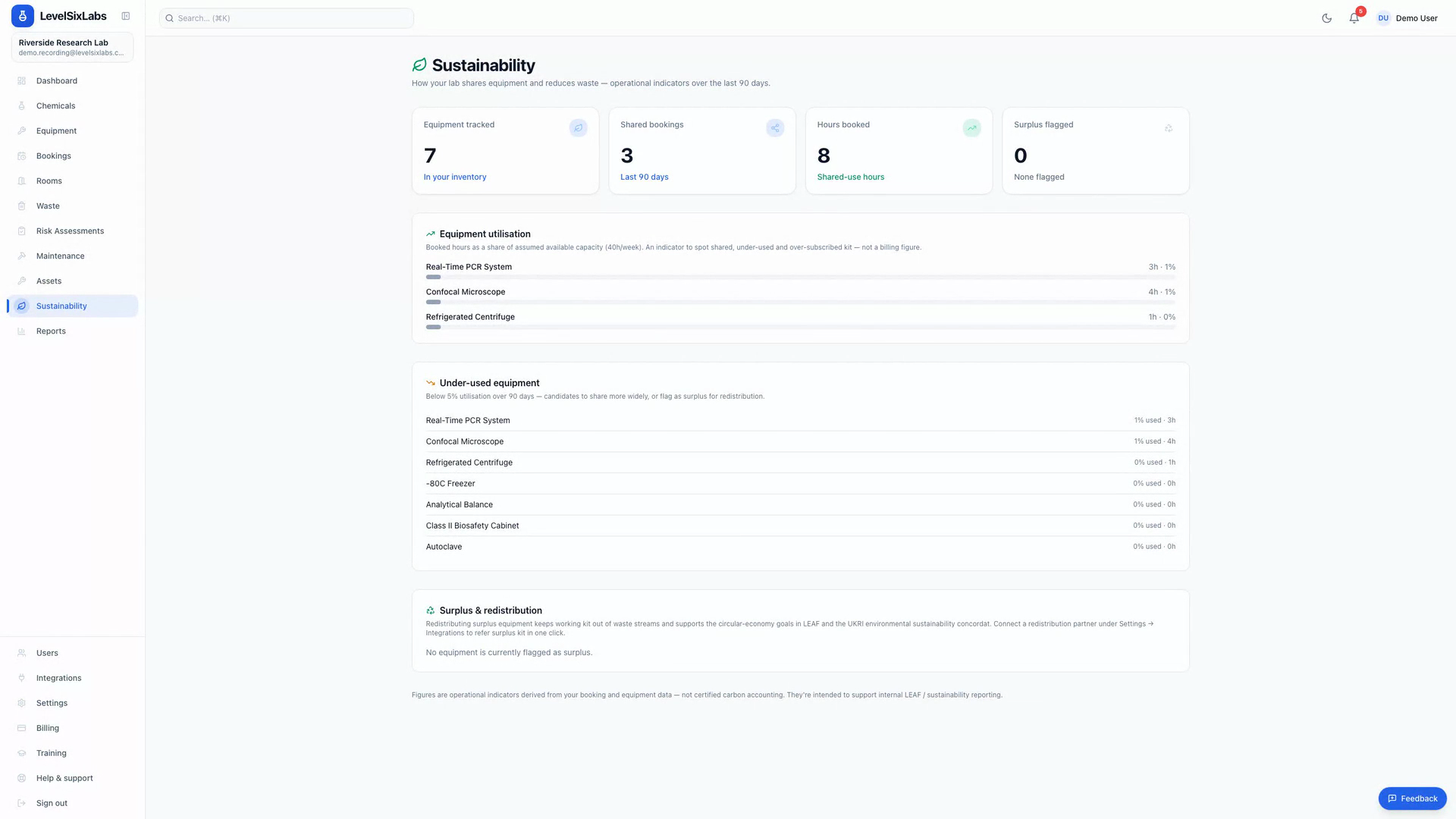
See it in action
Operational sustainability, not greenwashing
Recorded in the real app: equipment utilisation, shared bookings, under-used kit and surplus you can redistribute — all derived from real activity. No fabricated carbon numbers.
- Equipment utilisation over a rolling window
- Under-used kit flagged for sharing
- Surplus items you can refer for redistribution
Sustainability evidence — common questions
Does this calculate our carbon footprint?+
No — and we're deliberate about that. We don't produce certified carbon figures. The dashboard shows real operational indicators (equipment utilisation, shared use, under-used and surplus kit, waste records) that support your reporting.
How does it support LEAF, My Green Lab or the UKRI concordat?+
Two ways. The accreditation checklist gives you the LEAF Bronze, Silver or Gold criteria — or SPARKHub's actions, or a My Green Lab preparation checklist — to work through in the app, writing under each how your lab meets it, then exporting the criteria and your answers as a PDF for the assessment. And the sustainability dashboard organises the operational evidence those frameworks ask about — sharing, utilisation and waste reduction — in one place you can point to.
Is this LEAF, My Green Lab or SPARKHub certification?+
No. It's a self-assessment workspace — your working document, not a result. LevelSixLabs is not affiliated with or endorsed by UCL, UKRI or My Green Lab and does not submit, assess or award anything. My Green Lab in particular sets your level from its own assessment on its own platform. Criteria are summarised in our own words rather than reproduced, so always check your answers against the official versions on the awarding body's own platform before you submit.
Which criteria can you evidence from our own records?+
Roughly a third — concentrated in Equipment and Sample & Chemical Management, the categories labs find hardest to evidence: cataloguing coverage, equipment booking and sharing, cold-storage maintenance, fault handling, surplus redistribution and labelling. Each figure states exactly what was counted, and where you have nothing recorded it says so rather than showing a number. The rest of the criteria are yours to write.
Where do the numbers come from?+
From your real activity — bookings, equipment and waste records over the last 90 days. Utilisation uses an explicitly-stated capacity assumption shown on the page, so nothing is a black box.
What is surplus redistribution?+
You can flag equipment as surplus and, if your organisation opts in, refer it to a redistribution partner (e.g. UniGreenScheme) via a pre-filled email. It's opt-in and never automatic.
Run a more efficient lab
See your lab's operational picture.
Start your 14-day free trial. Full Pro access, no credit card required.